What Makes a Good Manager?
A perspective from someone who never was one

An old manager I still keep in touch with recently asked me a simple question:
“How could I be a better manager?”
I told them the truth:
I’m still learning what a good manager even looks like. But here’s the other thing, them asking me that means they respected my views. That in itself is signal for high intelligence for self-awareness.
I’ve never been a manager myself, so take this with a few grains of salt—and maybe a dash of pepper. But I have spent over six and a half years as an individual contributor, reporting to many managers, observing even more, and actively wanting to work for certain people who never officially became my manager.
In that time, I’ve had:
4 managers at Blue Origin in 1.5 years
5 managers at Tesla in 5 years (6 if you count my internship)
and now, a new manager at SpaceX
As I reflected on my career, I also had to ask a harder question: Was I the problem?
On paper, the churn looks bad—two managers a year at times. So I sat with it. The truth I arrived at was more nuanced.
The managers I deeply respected and wanted to keep working for didn’t part ways with me because of friction—we separated because of circumstance. Reorgs. Scope changes. Forces larger than either of us.
The managers who still had room to grow? I eventually left them.
When things are good, we take them for granted.
When things are bad, we give friction a chance to resolve—until one day it doesn’t.
This post isn’t about a single “great manager.” No one I worked for embodied all of these traits. Instead, these qualities were scattered across the best leaders I’ve had. I noticed them only in hindsight—once they were gone, or once I finally understood why I stayed as long as I did.
And if it helps create even a few more managers who lead with empathy, courage, and vision, it’s worth writing.
So what follows isn’t theory. It’s a view from the ground. From the people being led.
Technical competence earns trust before authority ever can
In engineering, this one matters.
If a manager doesn’t understand the work—the real work—they can’t accurately estimate timelines, tradeoffs, or risks. They don’t know when something is genuinely hard versus poorly scoped. And when things go wrong, they don’t know how to help.
A team should amplify a manager’s capability—not compensate for their absence.
The strongest managers I’ve seen had done the job themselves at some point. Maybe not yesterday, but enough to:
Step in if needed
Ask the right questions
Make data-driven decisions
Earn respect without demanding it
One of the most respected managers I worked with at Tesla was so technically trusted that Elon, himself, personally asked them to lead a project. That’s the bar.
Technically capable managers don’t say “trust me because I said so.”
They say “here’s the data, here’s the reasoning, here’s the risk.”
Warmth and Competence: the Charisma Balance
Vanessa Van Edwards frames leadership (past reflection on her book) beautifully with a simple 2×2:
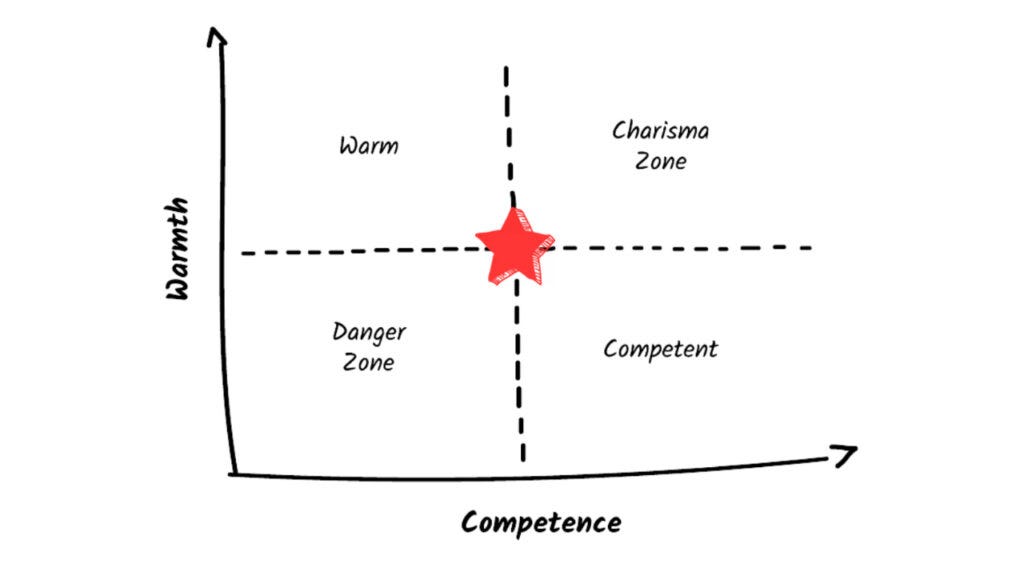
Warm but incompetent → well-liked, not trusted
Competent but cold → respected, not followed
Low warmth, low competence → dangerous
High warmth, high competence → the charisma zone
Great managers live in the top-right quadrant.
From this emerge the traits people actually care about:
Trust
Respect
Dependability
Expertise
Secure attachment
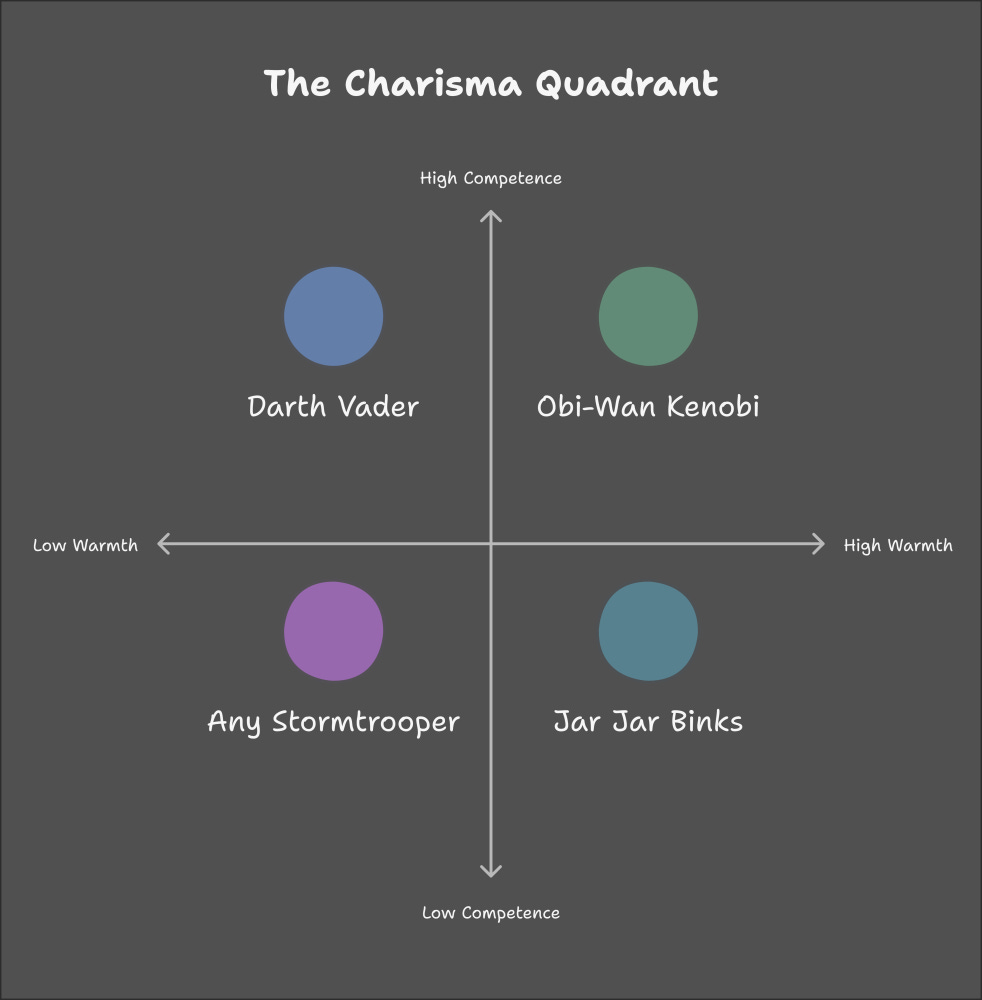
For you Star Wars fans:
Emotional intelligence is not optional—it’s infrastructure
People come first. Always.
Because when the job comes first, people eventually leave. And when people leave, other companies gain—not just talent, but tribal knowledge that can’t be documented or replaced.
Losing an employee isn’t just losing output.
It’s losing context, intuition, history, and trust.
Great managers understand this at every level—not just for engineers, but for everyone who makes the system work.
That includes:
Janitors who keep bathrooms clean
Food caterers who keep teams nourished
Facilities teams who make the space usable and ergonomic
Admins who quietly hold everything together
They’re not “support staff.” They are critical infrastructure.
Companies don’t run on org charts—they run on humans.
Managers with high emotional intelligence see the organization as a living system. They zoom out to understand how everything connects, but they can also zoom in to understand individual needs.
This is where Maslow matters—and not as a poster on the wall.
Physiological & safety needs: fair pay, clean spaces, reasonable hours
Belonging: psychological safety, inclusion, feeling part of a team
Esteem: recognition, trust, being seen as capable
Self-actualization: growth, mastery, purpose
Transcendence: mentoring others, contributing beyond oneself
When a manager supports someone up this hierarchy, motivation becomes intrinsic. People don’t stay because they have to. They become motivated to stay because they can transcend.
Boundaries, routine, and consistency create safety
I deeply respect managers who know how to say no—and say it with clarity and grace.
Not aggressively. Not dismissively. But clearly—and with rationale.
Boundaries signal values.
Consistency builds trust.
Routine creates dependability.
Managers who say no upstream—who defend their team when pressure comes from above—earn lifelong respect. What also surprised me was how much respect flows both ways.
Just like with children, healthy boundaries are not cruelty. They’re care.
One manager I admired immensely at Tesla had strong boundaries. They defended their team. They said no upstream. They were consistent. Unmovable in their values.
For a long time, I tried to earn their approval. To be seen. To prove myself.
What I didn’t realize was that the moment I learned to say no myself, something shifted. They respected me because I had boundaries too.
When a manager says something, and you believe it will either happen—or be transparently revisited if it doesn’t—that’s leadership.
On my final day at Tesla, as I was leaving the office, they were the last person to wish me well. It was quiet. Simple. Sincere.
I almost shed a tear.
That respect wasn’t granted. It was earned—through consistency, values, and mutual understanding.
Let people fail—but be there when they fall
Being a manager is a lot like parenting.
You don’t prevent every scraped knee. You let people try, fail, and learn—with psychological safety.
A team that’s afraid to fail becomes anxious.
A team that doesn’t feel safe to speak up becomes avoidant.
And just like attachment styles in families, they show up at work too.
Psychological safety allows people to:
Take risks
Surface problems early
Communicate openly
Solve hard things together
One manager at Tesla once told me something that stuck:
“Managers are servants to their team.”
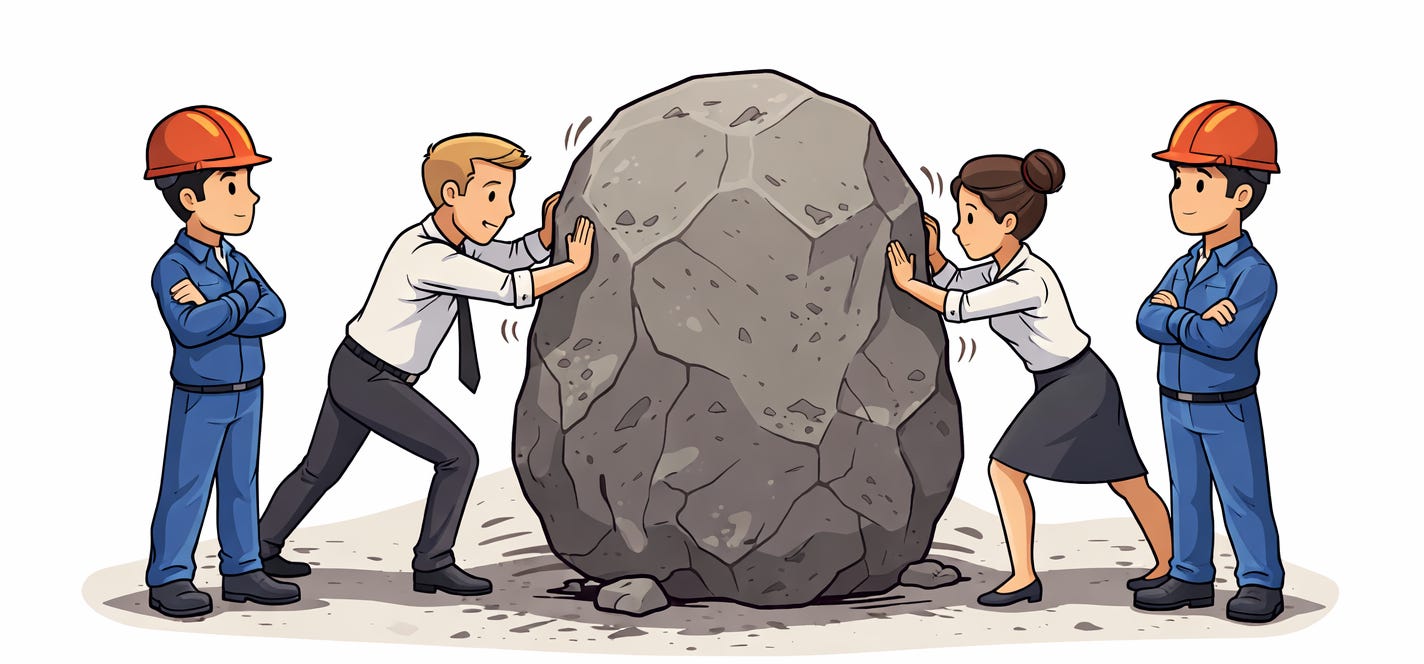
They used this analogy:
If two engineers are blocked by a boulder between them, the manager’s job isn’t to yell—it’s to help (or figure out how to) move the boulder. That’s how progress actually happens.
Praise in public. Coach in private.
One of the best managers I ever worked with reviewed my presentation before I presented to an executive.
They didn’t need credit.
They wanted me to succeed.
In the room, they backed me completely.
Behind closed doors, they gave feedback.
Public praise builds confidence.
Private feedback preserves dignity.
Shame has no place in leadership.
Ask for feedback—constantly
Asking for feedback is an act of humility.
It says: I don’t know everything.
It softens ego.
It invites alignment.
Julie Zhuo, in The Making of a Manager, talks about being thrown into leadership early. Her biggest lesson?
Ask for 360 feedback. Always.
Age doesn’t matter. Title doesn’t matter.
Respect flows both ways.
A manager gives more than they take
A pattern I’ve noticed across the best leaders is simple:
They give more than they take.
Adam Grant writes about this in a book I previously read, Give and Take, using George Meyer—the creative force behind The Simpsons—as an example.
George Meyer wasn’t the loudest voice in the room. He didn’t hoard credit. He gave ideas away freely. And in doing so, he elevated everyone around him.
The result?
His team did the best work of their lives.
Managers like this shine the light outward. They create space for others to succeed. They don’t need the spotlight because their impact is visible through their people.
The best managers understand that leadership is not extraction—it’s multiplication.
Attachment styles show up at work—whether we like it or not
Managers set the emotional tone.
An anxious manager spreads anxiety
An avoidant manager creates silence and assumptions
A secure manager creates calm, clarity, and trust
Secure managers say:
“I don’t know—let’s find out”
“This is hard, and we’ll figure it out together”
“If this fails, that’s on me”
Teams mirror their leaders. Always.
Closing
I’ve never been a manager.
But I’ve been shaped by many—by their strengths, their blind spots, and the spaces in between.
These traits don’t live in one person. They live across many moments, many leaders, and many lessons that only make sense in hindsight.
If you’re managing people—or about to—you don’t need to be perfect.
You just need to care deeply, reflect honestly, and remember:
Leadership isn’t about being above people.
It’s about standing with them—and sometimes, standing in front so they don’t have to.