Sapiens - Are We Screwed?
300,000 years of evolution only to lead to deeper self-reflection

416 pages in 20 days — about 20 pages a day. It helped considerably by a long flight where I finally had nowhere else to be and nothing else to pretend required my attention.
There’s something I’ve been noticing the more I read: the ability to absorb what matters and quietly discard what doesn’t is a skill that compounds. Speed reading isn’t really about speed. It’s about signal-to-noise ratio — training your mind to recognize what’s essential and release the rest without guilt. The more you read, the better you get at it. Which is reason enough to just start, regardless of the book.
But this post isn’t going to be about reading habits.
It’s my commentary on Sapiens — my first book on history. Harari left me with a mirror. And what it made me reflect wasn’t exactly comfortable.
Where We Came From
Harari opens Sapiens long before Homo sapiens existed — back when the earth hosted multiple human species simultaneously. Homo neanderthalensis. Homo erectus. Homo soloensis. Homo floresiensis. Cousins, all of them, walking the earth at the same time, each adapted to their environment, each carrying something recognizably human in their bones.
What happened to them is still partially a mystery. Some interbred with our ancestors — traces of Neanderthal DNA persist in people of European and Asian descent today. Others simply disappeared. We are, in some meaningful sense, the “last ones” standing.
And here’s what that made me think: we spend so much energy classifying ourselves. Race. Ethnicity. Size. Skin color. Facial geometry. The particular geography our ancestors happened to occupy thousands of years ago. We build identities around these classifications, fight wars over them, use them to decide who belongs and who doesn’t.
Our differences divide us, our commonality unites.
But once you zoom out far enough — once you see the full picture of where we actually came from — the classifications start to look like what they are. Stories we tell ourselves to create the illusion of difference in a species that is, at its core, remarkably, almost stubbornly, the same.
We all just want to be seen. To belong. To love and be loved. To find meaning in the years between birth and death.
The Neanderthal probably wanted that too.
Adlerian Interruption
Here’s where I want to pause on something Harari gestures at but doesn’t fully name — and where I think another thinker fills the gap.
We are obsessed, as a culture, with origin stories. Where did we come from. What shaped us. What our ancestors did and what was done to them. What our childhood explains about our present behavior. We dig backward, convinced that if we can just understand the root, we can understand the tree.
Alfred Adler — one of Freud’s contemporaries, and in many ways his most interesting critic — would push back on all of this, in a pragmatic way. Yes, he said, the past influences who you are. But it does not determine who you become. In this present moment, you have free will. You can make a different choice today than you made yesterday. And that choice reshapes tomorrow. And if tomorrow’s choice doesn’t work, you can make another one the day after.
The past is real. But is is not a life sentence.
No experience is a cause of success or failure. We do not suffer from the shock of our experiences, so-called trauma — but we make out of them just what suits our purposes." — Dr. Alfred Adler
What troubles me about our cultural obsession with excavating where we came from — ancestrally, psychologically, historically — is the opportunity cost. Every hour spent trying to define the self through its origins is an hour not spent building the self toward where it wants to go. And in the process of looking backward so intently, we miss something irreplaceable: the present moment. The person sitting across from us. The conversation that doesn’t happen because we were somewhere else in our heads.
Harari traces 300,000 years of human history. Adler says: what are you going to do today?
Both matter. But only one of them you can actually execute an action for.
What We Destroyed in Building All of This
This is the part of Sapiens I couldn’t stop thinking about.
We are, Harari argues, a species that has never been more connected and never been more alone. And I think he’s right. But I want to say it more plainly than he does.
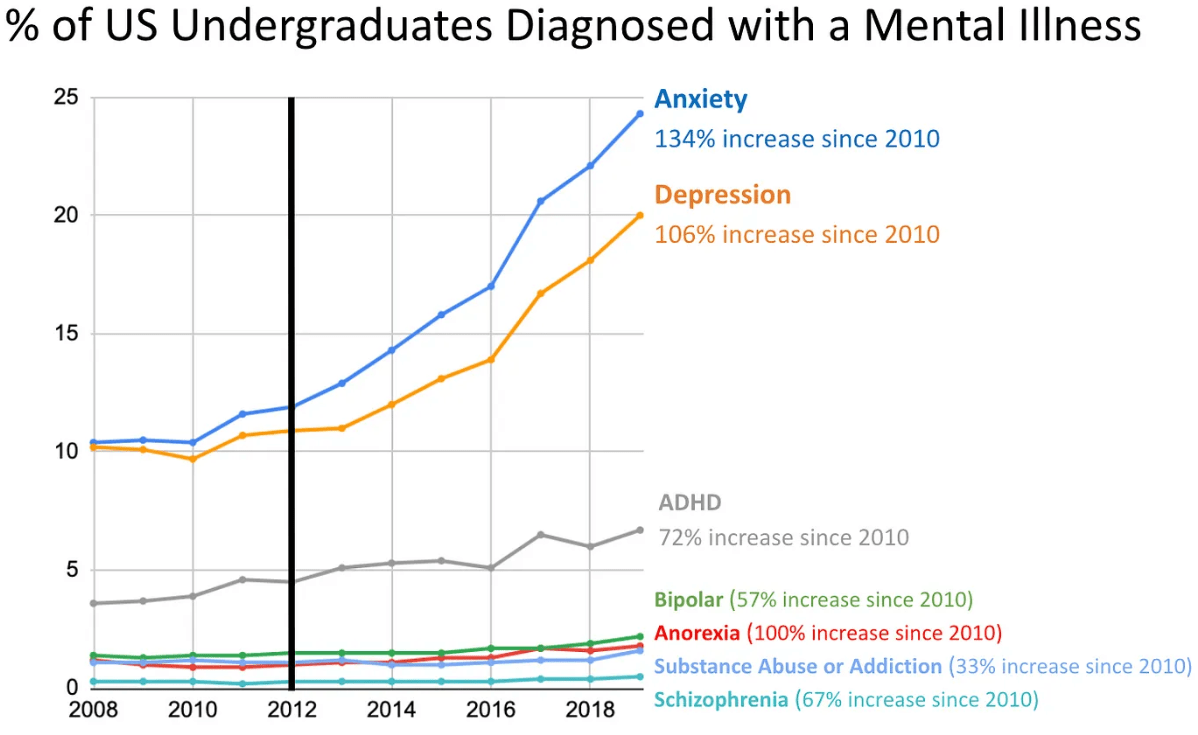
We took the village and replaced it with an apartment complex. Two hundred people living within thirty feet of each other, separated by drywall and the unspoken agreement that proximity does not equal community. We go to work independently, come home independently, consume entertainment independently, and if we want to feel the sense of belonging that every human nervous system is wired to need — well, we have to find it. Schedule it. Optimize it. Add it to the calendar between the gym and the grocery run.
The hunter-gatherer didn’t schedule community. Community was the entire architecture of life. The hunt required it. The meal required it. The ritual required it. Belonging is something you are born into and maintained every day through the simple act of living alongside people who needed you and whom you needed back.
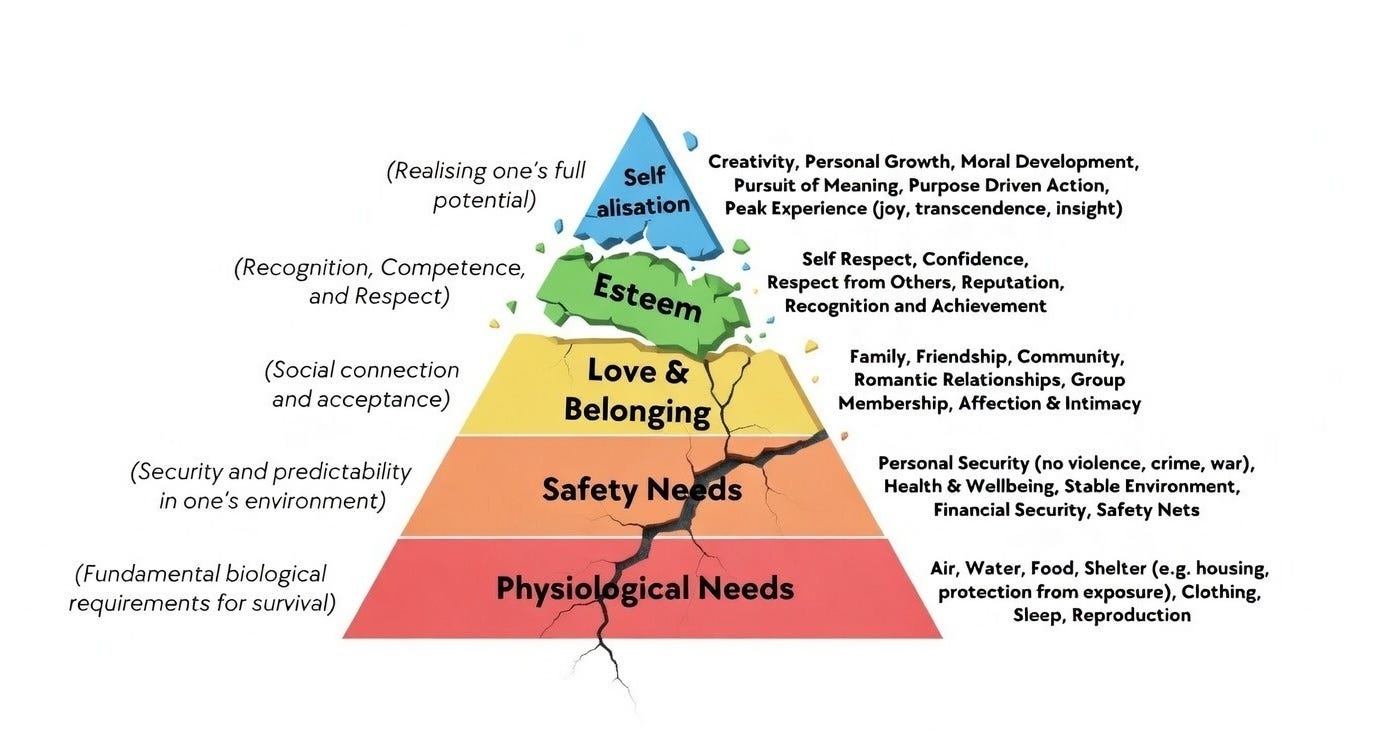
Maslow mapped this: at level three of his hierarchy sits belonging — the need to be part of something, to be known, to matter to a group. At level four sits esteem — the need to feel capable and respected. Self-actualization, the peak, is only accessible once those foundations are secure.
What consumer capitalism has done — with breathtaking efficiency and zero malice, which somehow makes it worse — is systematically erode levels three and four while appearing to offer them. Buy this product and belong. Achieve this metric and matter. The ads don’t sell things. They sell the feeling of adequacy that community used to provide for free, embedded in the fabric of daily life.
And then LinkedIn shows you a billionaire 25-year-old’s success while you’re eating lunch at your desk.
We pushed ourselves down the pyramid and called it progress.
The Barefoot Thought Experiment
Here is one of the stranger places Sapiens took my thinking, and I want to share it because it’s the kind of thing you can’t unthink once it arrives.
We evolved over hundreds of thousands of years to walk on earth. Bare feet on soil, grass, rock, sand. And then we paved it. Concrete roads, concrete sidewalks, concrete floors — and then, because concrete is hard and cold and unforgiving, we invented shoes. And because shoes wear out, we built factories to make them. And because factories produce waste, we built systems to manage it. And because the shoes eventually end up in landfill, we invented recycling. And because recycling is complicated, we built more machines.

We added a part. The part required ten more parts. Each of those required ten more.
This is, in miniature, the story of modernity. We solve a problem we created by solving a previous problem we created. Each solution is genuine — concrete is more efficient for transportation, shoes do protect feet from injury — and yet the compounding complexity of it all produces a system so elaborate, so resource-hungry, so dependent on a thousand invisible supply chains, that we’ve lost the ability to see it clearly.
I’m not arguing we go back to bare feet. I’m asking Harari’s question in a different register: at what point does the addition of parts make the system more fragile rather than more functional? And are we humble enough, as a species, to ask that question before necessity forces the answer?
Southern California is, to me, a living case study. We keep building inland — Temecula, Riverside, further and further from the coast — because the places near water, near the source of life, have become so dense and expensive and stressed that people steal from each other and burn things down just to feel some agency over their circumstances. We designed a system that punishes proximity to resources and rewards those who can afford to insulate themselves from the consequences. The poor buy cheaper cars that break more often, consume more fuel, cost more to maintain — and work harder to cover the difference. The rich get further from that math with every passing year.
Capitalism calls this opportunity. Harari calls it something more complicated. I call it a human design flaw we keep patching instead of fixing.
We Have Not Learned Anything
Harari ends Sapiens reaching, somewhat tentatively, toward optimism. The merger of man and machine. Neuralink interfaces. Cyborg enhancements that allow the brain to communicate directly with mechanical extensions of the body. Reusable rockets, interplanetary travel. The possibility that we are approaching a threshold of capability so profound it will redefine what it means to be human.
And then he asks — quietly, almost as an aside — the question that undoes all of it:
But will we be happy?
Because here is the thing. We have been at this for 300,000 years. We have built civilizations and watched them fall. We have written every philosophy, every religion, every self-help framework the human mind is capable of producing. We have mapped our own psychology, sequenced our own genome, split the atom, walked on the moon.
And we are still fighting wars over the same things. Resources. Religion. The need to dominate. The fear of the other. The ancient, unresolved anxiety of a species that never quite figured out how to feel safe enough to stop.
The technology has changed. The wisdom has not kept pace.
We have not learned. Or rather — we have learned, repeatedly, and then failed to implement. The knowledge exists. The philosophy exists. The science of human wellbeing exists. And we still build missiles. We still manufacture inadequacy to sell products. We still let the rich get richer while the systems designed to lift everyone calcify into mechanisms that mostly lift those already elevated.
Harari doesn’t end with a solution, and I don’t have one either.
But I think the question he’s really asking — underneath the history and the science and the speculation about cyborgs — is whether we will ever take the knowledge we have accumulated and actually live by it. Whether we will close the gap between what we know and what we do. Whether wisdom will ever catch up to capability before capability outruns our ability to manage it.
Then What?
This is the question I kept returning to through all 416 pages.
We trace our lineage to Homo erectus. Then what? We understand our childhood wounds. Then what? We map our ancestral trauma, our genetic inheritance, our evolutionary programming. Then what?
At some point, the excavation has to give way to construction. Creation. Builders.
Adler was right. The past is real and it matters and it shaped you and it will always be part of you. But it is not the point. The point is what you build today, with what you have, in the direction of the life you actually want.
Harari traces the entire arc of human history and arrives at a human in 2026, sitting in an apartment complex, not knowing their neighbors, consuming content designed to make us feel inadequate, working a job to pay for things we were convinced we needed, wondering what it all means.
That humanity has 300,000 years of accumulated wisdom available to them. Every philosophy. Every religion. Every psychology. Every story ever told about what makes a life worth living.
The question is whether we’ll read any of it.
And then — more importantly — whether we’ll do anything differently tomorrow.
“We are more powerful than ever before, but have very little idea what to do with all that power.” — Yuval Noah Harari, Sapiens